Rechercher dans ce blog

Jumat, 02 Juli 2021

Newfoundland and Labrador Set to Become Most Vaccinated Population for First COVID-19 Doses in North America - VOCM

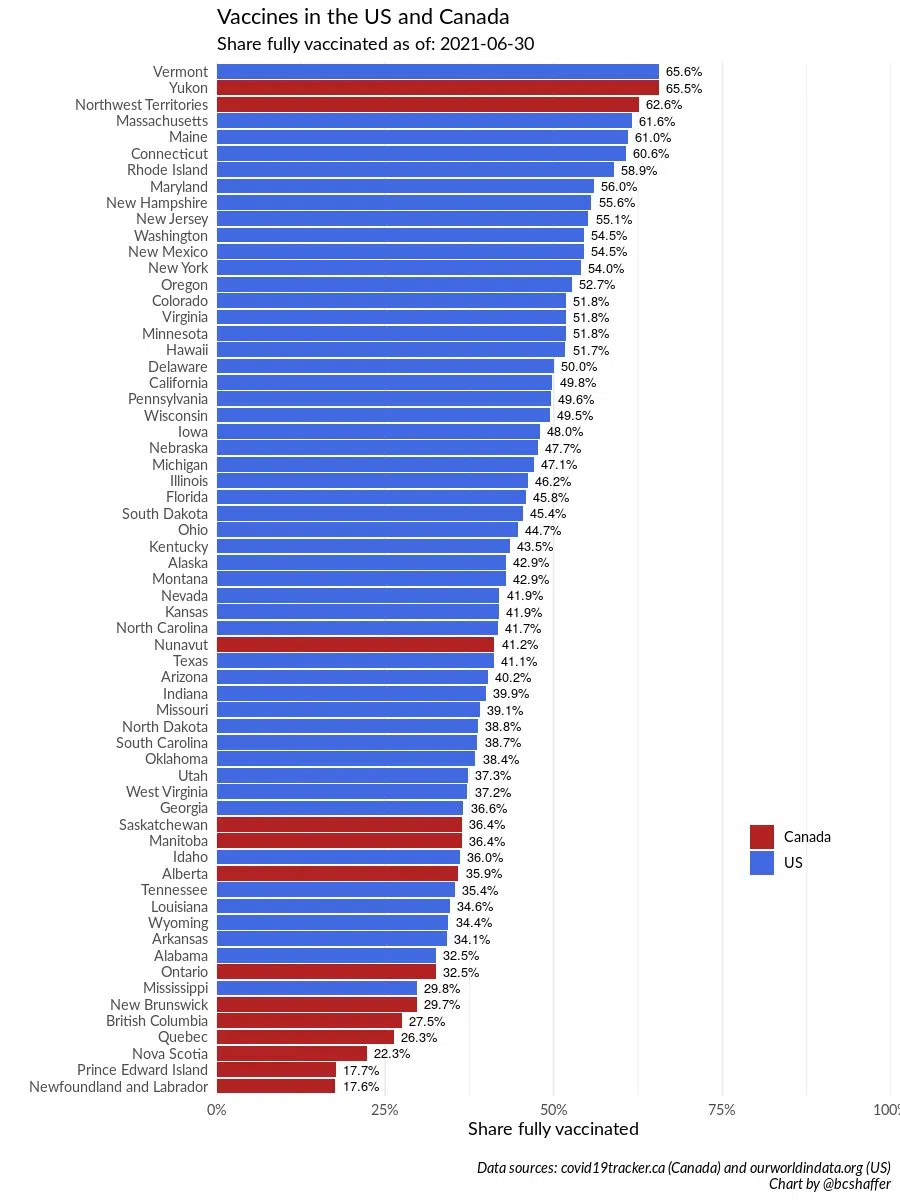
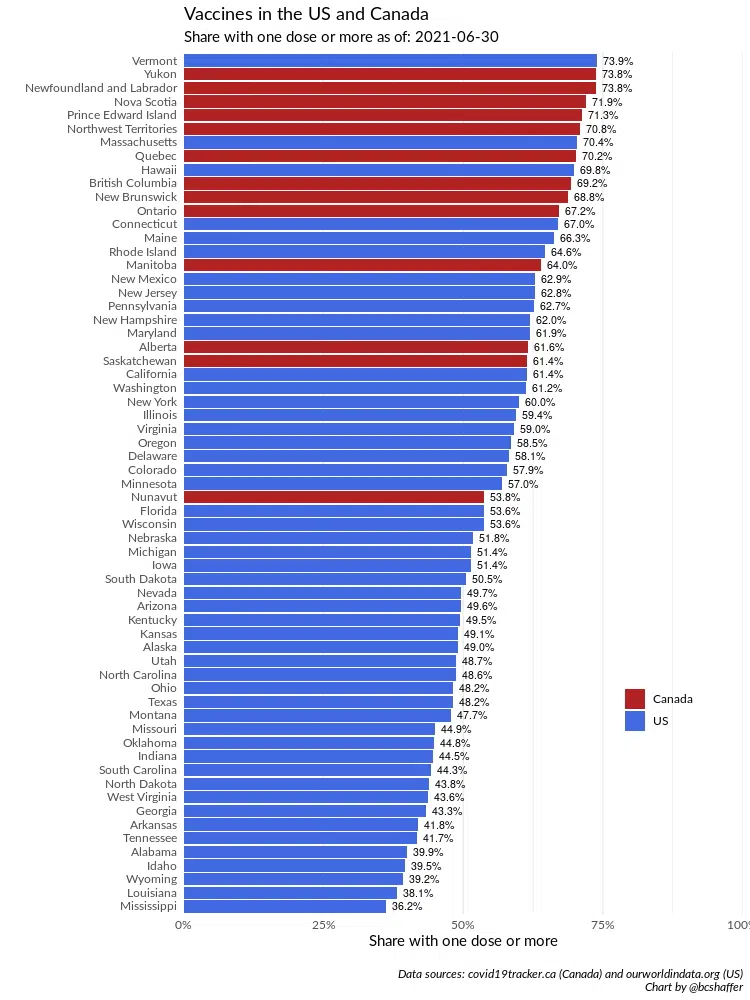
Newfoundland and Labrador is poised to become the most vaccinated place as a percentage of population in North America.

This is based on first vaccinations according to Blake Shaffer, an Assistant Professor of Economics at the University of Calgary.

Health Minister John Haggie says 80 per cent of the population is set to have had their first dose by the end of this week.

However, in terms of second doses of vaccines, the province is at the bottom according to Shaffer, sitting at just below 20 per cent.

Meanwhile, the Public Health Agency of Canada says Pfizer-BioNTech is sending more than 2.4 million doses to Canada this week along with about 1.4 million from Moderna.

Another 18 million doses are expected in July, enough to fully vaccinate all 33.2 million Canadians over the age of 12.

Adblock test (Why?)


Newfoundland and Labrador Set to Become Most Vaccinated Population for First COVID-19 Doses in North America - VOCM
Read More

Gold price jumps as U.S. job numbers beat expectations but unemployment rate rises in June - Kitco NEWS

(Kitco News) Gold rose to daily highs after the U.S. added more jobs than expected in June but the unemployment rate ticked up.

U.S. nonfarm payrolls rose by 850,000 in June, according to the Bureau of Labor Statistics. The monthly figure came well above market consensus estimates of 700,000.

However, the U.S. unemployment rate rose to 5.9%, while markets projected to see a drop to 5.7%. The number of unemployed also remained at 9.5 million.

“These measures are down considerably from their recent highs in April 2020 but remain well above their levels prior to the coronavirus (COVID-19) pandemic (3.5 percent and 5.7 million, respectively, in February 2020),” the report noted.

The most active sectors were leisure and hospitality, public and private education, professional and business services, and retail trade.

The labor force participation rate was unchanged at 61.6% in June. Meanwhile, wages, another key element in the report, edged down, with average private wage growth coming in at 0.3% May’s 0.4% advance.

"The mix of jobs added being tilted towards lower-paying services resulted in average private wage growth decelerating to 0.3%, despite those services seeing notable upward pressure on wages due to the labor shortage," said CIBC Capital Markets economist Katherine Judge.

Gold prices moved higher and neared daily highs after the data were released. August Comex gold futures were last trading at $1,790.90, up 0.79% on the day. 

Live 24 hours gold chart [Kitco Inc.]

Adblock test (Why?)


Gold price jumps as U.S. job numbers beat expectations but unemployment rate rises in June - Kitco NEWS
Read More

OPEC+ fights over oil output with inflation outlook at stake - BNN

OPEC+ allies were locked in a tense diplomatic standoff on Friday after a dispute that threatens to send oil prices sharply higher.

As of Friday afternoon in London, the group had failed to find a way out of the impasse, with both sides entrenched in their demands, delegates said. If the negotiations fail, the fallback position is that there’ll be no increase in output, one of them said. That would squeeze an already tight market, risking a further inflationary price spike.

“If OPEC+ fails to reach a compromise, the automatic fallback will be to roll over current quotas into August and beyond,” said Matthew Holland, a geopolitical analyst at consultant Energy Aspects Ltd. “That would lead to sharply higher prices, something most OPEC+ members want to avoid.”

Embedded Image

Ministers reconvened on Friday after the meeting was halted the evening before because of the dispute. It’s not the first time the group has faced such crises, and more often than not it has been able to fudge a diplomatic solution.

The disagreement centers on how the group measures its production cuts, with the United Arab Emirates refusing to back a deal to raise output unless the baseline for its own curbs is increased, according to delegates. The UAE is ready to accept no change in output for August if an agreement can’t be reached, one delegate said. It’s not clear if that stance would be acceptable to Russia, however.

On Thursday, the Organization of Petroleum Exporting Countries and its allies had appeared to be heading for a deal to add about 400,000 barrels a day of crude to the market each month from August to December. But the UAE put up objections at the last minute and the online meeting was paused.

Resolution may not be easy, because giving the UAE what it wants -- essentially a much higher production limit -- could upend the entire OPEC+ deal that’s buttressed oil prices since the start of the COVID-19 pandemic.

“Any request to adjust the production quota would be like opening Pandora’s box,” said Giovanni Staunovo, a commodity analyst at UBS Group AG. That could allow an output increase of about 700,000 barrels a day for the UAE alone, and “other OPEC+ states might also request an adjustment.”

Several delegates said the issue was so serious that it could only be resolved by talks at the highest level of government.

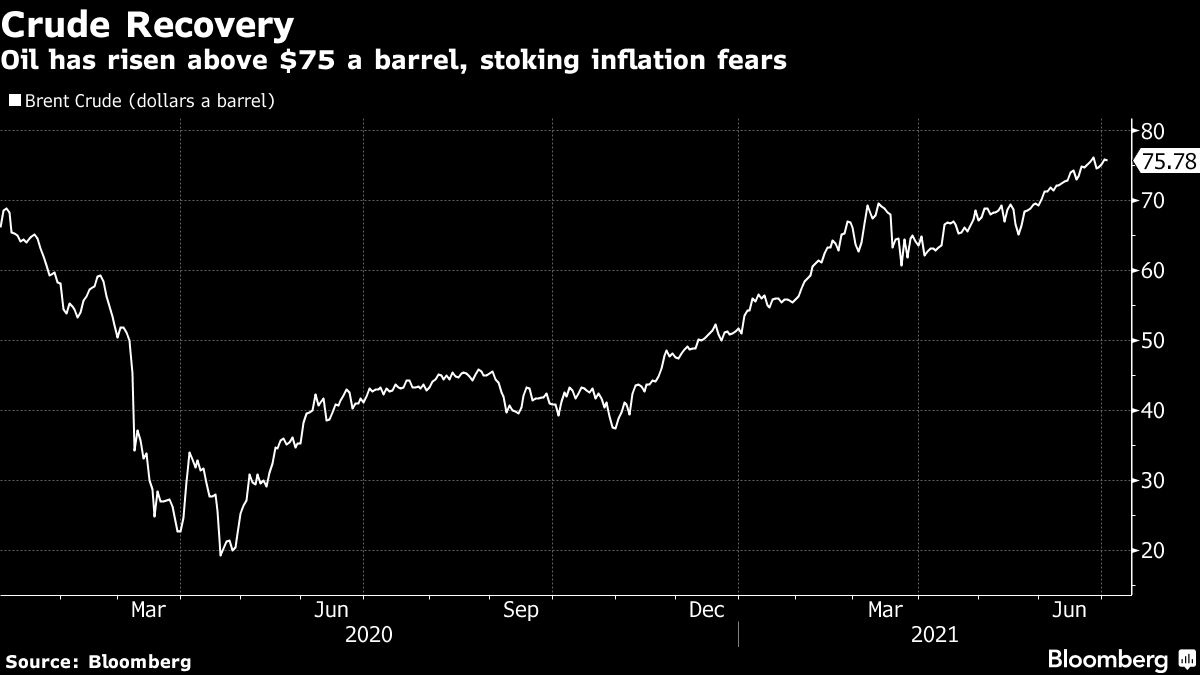
The standoff leaves the market unsure whether it will be grappling with a huge supply deficit in the second half of the year, with crude this week rising above US$75 a barrel in New York for the first time since 2018. It also tarnishes the cartel’s carefully reconstructed reputation, raising the specter of another destructive internal dispute -- the Saudi-Russia price war that helped to crash the oil market last year.

The UAE’s ambitions have upset negotiations before. Late last year, Abu Dhabi even floated the idea of leaving the cartel as it pressed to raise production. An OPEC meeting was postponed then too amid fraught negotiations, though a deal was ultimately struck.

The problem is a consequence of the UAE’s heavy investment in new additional capacity. The country’s cuts are measured from a starting point in 2018, setting its maximum capacity at about 3.2 million barrels a day. Expansion projects have since raised that number and the country wants its baseline reset to about 3.8 million barrels a day so it can use its new fields, delegates said.

The UAE argues that the change is necessary because, under the current terms of the OPEC+ deal, it is making proportionally deeper cuts than other members. The proposal on Thursday to delay the expiry of the output curbs from April to December 2022 exacerbated the issue.

“Clearly, the UAE is playing hardball and has signaled previously its frustration with production levels,” said Neil Quilliam, associate fellow in the Middle East and North Africa program at the Chatham House think tank. “It is unlikely that the UAE is willing to derail negotiations, this time around, though its appetite for doing so is growing, and future rounds are likely to be spikier.”

Red lines

For the UAE, the baseline is a very significant issue and it will reject the OPEC+ deal until there’s a change, a delegate said after the meeting was adjourned. The Saudis are equally insistent that the extension of the agreement until December 2022 is vital for market stability next year.

Failure to bridge the gap would leave the existing OPEC+ deal in place, keeping as much as 5.8 million barrels a day off the market until April 2022.

Oil has risen around 50 per cent this year, with the recovery in demand from the pandemic outpacing the revival of OPEC+ supplies after last year’s deep cuts. Crude’s surge, combined with a rally in other commodities, has central banks fretting about inflation again. Brent was broadly flat on Friday.

OPEC+ is already in the process of reviving crude supplies halted last year in the initial stages of the pandemic. The 23-nation coalition decided to add about 2 million barrels a day to the market from May to July. But there was a growing clamor for the group to keep going.

The cartel’s own data show that once-bloated oil inventories are back down to average levels as a strong revival in fuel consumption continues. Demand in the second half will be 5 million barrels a day higher than in the first six months of the year, OPEC Secretary-General Mohammad Barkindo said on Tuesday.

“You still need around 2 million barrels a day at least for the second half of the year to just keep the market in a reasonable sense of supply and demand balance,” Neil Beveridge, a senior analyst at Bernstein Research, said on Bloomberg TV.

Adblock test (Why?)


OPEC+ fights over oil output with inflation outlook at stake - BNN
Read More

Robinhood IPO To Tap Meme Stocks Crowd As Filing Reveals Soaring Growth - Investor's Business Daily

[unable to retrieve full-text content]

  1. Robinhood IPO To Tap Meme Stocks Crowd As Filing Reveals Soaring Growth  Investor's Business Daily
  2. Robinhood Reveals Surging Loss This Year After 2020 Profit  Yahoo Canada Finance
  3. Robinhood Warns of Meme-Stock Risk as Users Participate in IPO  BNN
  4. Robinhood IPO Filing Is a Lesson in Meme Finance  Bloomberg
  5. The 5 most eye-popping disclosures in Robinhood's long-awaited IPO filing  MarketWatch
  6. View Full coverage on Google News

Robinhood IPO To Tap Meme Stocks Crowd As Filing Reveals Soaring Growth - Investor's Business Daily
Read More

Pump prices expected to continue climb as oilpatch eyes better days ahead - CBC.ca

With oil prices recently returning to some of their highest levels in years, experts say drivers should prepare to pay even more at the pumps as the summer driving season begins.

Those higher crude prices may help lift hopes for better days in Canada's oilpatch, but it's also contributed to higher gasoline prices as fuel demand starts to take off.

"I'm always not wanting to fill it up all the way," said Peter Bleumortier, while fuelling a pickup truck last weekend in Vancouver, where prices had climbed to $1.70 a litre. "It's like breaking the bank."

The North American benchmark oil price has marched from below $50 US per barrel at the start of the year to well over $70 US a barrel more recently, nearing 2018 highs. It has had some talking again about $100 a barrel oil by next year.

It comes as the market broadly expects COVID-19 vaccines to bolster global oil demand, though there are concerns over the potential impact of the new delta variant

Markets will be watching Friday when the oil-producing nations of OPEC are expected to decide how much to increase crude output over the coming months.

Canadian gasoline prices have also reached some of their highest levels in the last five to seven years, according to Patrick De Haan, head of petroleum analysis at GasBuddy.

A year ago, in April 2020, the average gasoline price in the country had plunged to 76 cents, he said. Earlier this week, the average Canadian gasoline price was around $1.36 per litre, according to GasBuddy.

And De Haan believes pump prices could continue climbing for a while yet.

GasBuddy's Patrick De Haan doesn't expect higher prices to hold back consumer demand, with people itching to hit the road.

"We will probably not see a peak in price for another potentially four weeks as demand is likely to continue to increase," De Haan said in an interview this week.

"Keep in mind that the pandemic is just beginning to really ease in Canada. And over the next four weeks, as more people feel better about getting out, they're going to do so."

He doesn't expect higher prices to hold back consumer demand.

"Even if [gasoline] prices do reach record highs, I don't think that many Canadians are going to be persuaded to stay home this summer," he said.

The rise in fuel and oil prices may also affect the price of other goods, like airline tickets, groceries and other commodities, De Haan said. 

Economist Rory Johnston said higher oil prices can also help lift the value of the dollar, as well as government revenues from taxes and energy royalties.

"I think that the Canadian oilsands are also looking like they're going to have really, really strong cash flows, really strong profitability," said Johnston, managing director at the Toronto-based Price Street.

"That's going to mean higher corporate taxes. It's going to mean higher personal taxes for those people that are still on payroll." 

Higher oil prices are good news for oil companies aiming to rebuild their balance sheets after the sector borrowed heavily to survive a long downturn that saw thousands of layoffs.

Companies are also navigating a shifting energy landscape, including climate change, carbon policies and the long-term outlook for fossil fuel demand

Analyst Jeremy McCrea said while company cash flows are improving, he doesn't expect a big rebound in capital spending or employment in the industry this year.

"Jobs [will] come back a little bit," said McCrea, who is with Raymond James and based in Calgary. "You're going to see some spending pick up there, but very, very marginally."

PetroLMI’s most recent data shows a steady rise in the number of exploration and production jobs in Alberta, from December through May. (Todd Korol/Reuters)

This spring, PetroLMI's labour market outlook forecast "modest" growth in oil and gas jobs in Canada beginning next year, with recruitment for skilled workers becoming a concern.

The organization's most recent data shows a steady rise in the number of exploration and production jobs in Alberta from December through May.

Some say it feels like things are beginning to turn around now.

Adam Waterman, a service rig co-ordinator with Baytex Energy, said there are already signals things are picking up again.

"Across the province, I hear that we're iron rich and man poor," Waterman said recently while working at the site of a former natural gas well near Camrose, Alta. "I haven't been this bullish on Canadian energy for a lot of years."

Scott Darling, president of Performance Energy Services, said his company was already busy doing abandonment work on well sites. 

With $70 US oil, he thinks production work in the oilpatch will pick up again, increasing the competition for workers.

"People have left the province; [it's] really hard to attract them back," he said.

Adblock test (Why?)


Pump prices expected to continue climb as oilpatch eyes better days ahead - CBC.ca
Read More

Robinhood Reveals Surging Loss This Year After 2020 Profit - Yahoo Finance

(Bloomberg) -- Robinhood Markets Inc. filed for an initial public offering, disclosing it became profitable last year only to have its losses skyrocket in the first quarter amid the so-called meme stock frenzy, in what’s expected to be one of the highest-profile listings the year.

The company, which pitches its trading platform to novice investors, listed the size of the offering as $100 million, a placeholder that will change when it sets terms for the share sale. Thursday’s registration statement follows Robinhood’s announcement in March that it had filed confidentially to go public.

Robinhood said it generated net income of $7.45 million on net revenue of $959 million in 2020, compared with a loss of $107 million on $278 million the previous year, according to the filing.

The company’s revenue surged during the first quarter, exceeding $522 million compared with $128 million for the same period last year, according to the filing. Its losses rose astronomically, though, from $53 million for the three months ended March 31, 2020, to $1.44 billion in the most recent quarter.

That loss was mainly tied to convertible notes and liabilities from its emergency fundraising, when it was rushing to deal with the volatility of trading in GameStop Corp. and other popular stocks. Robinhood gathered more than $3 billion from investors over a few days

Cryptocurrency trading on Robinhood was booming in the first quarter, with 17% of its total revenue involving transactions related to it.

Robinhood’s potential valuation will be more clear when it discloses the number of shares it plans to sell and the proposed price range for them. Bloomberg Intelligence analyst David Ritter has said the company could be worth as much as $40 billion.

‘Meme-Stock Frenzy’

Robinhood’s appeal caught on during the coronavirus pandemic as homebound young people turned to online trading to pass the time and make money. Its monthly active users have more than doubled in the past year, with 17.7 million as of the first quarter, up from 8.6 million in the same period last year.

That increased popularity has led to scrutiny from politicians and regulators, who are focused on the so-called gamification of trading and the company’s role at the center of the meme-stock phenomenon.

Robinhood also had to raise billions of dollars from its backers, at the height of a volatile late January frenzy over stocks like GameStop, that became popular on Reddit forums and trading apps.

The Financial Industry Regulatory Authority imposed a nearly $70 million fine on Robinhood on Wednesday, a record for the watchdog. Finra alleged Robinhood misled its customers about margin trading, and lapsed in its oversight of technology and approvals for options traders. Robinhood neither admitted nor denied the claims.

Younger, Diverse

Robinhood declares in its filing that its mission is to “democratize finance for all.”

Robinhood was founded by two Stanford alumni Baiju Bhatt and Vlad Tenev who met at the university. Both are sons of immigrants and raised in rural parts of the U.S.

“The next generation of investors is younger and more diverse than ever before, and finance is now as culturally relevant as music and the arts,” Tenev and Bhatt said in a letter to investors.

The company warns in its filings, though, that “unfavorable publicity has in the past adversely affected, and could in the future adversely affect, our reputation.”

The Menlo Park, California-based company said in the filing it will reserve 20% to 35% of its Class A shares for its customers.

The company will have two other classes of stock, with Class B shares carrying 10 votes each and Class C shares with no voting rights. All of the Class B shares will be held by executives and directors of the company after IPO, according to the filing.

Top Shareholders

Robinhood’s top shareholders are venture firms DST Global, Index Ventures, New Enterprise Associates and Ribbit Capital. Each group owns more than 5% of Robinhood stock leading into the offering.

The listing gives 2021’s IPO market another boost. So far companies, including blank-check firms, have raised more than $210 billion on U.S. exchanges, the busiest year on record, according to data compiled by Bloomberg. Consumer-facing companies such as Warby Parker Inc., Sweetgreen Inc. and Allbirds Inc. are expected to make their public debuts later this year, Bloomberg News has reported.

Robinhood said in June that new directors would be joining its board including Jon Rubinstein, who helped create the iPod for Apple Inc. and is a director at Amazon.com Inc., Robert Zoellick, the former president of the World Bank and PricewaterhouseCoopers partner Paula Loop.

Bank Creditors

The company’s credit lines include a $600 million revolver from banks including JPMorgan Chase & Co., Goldman Sachs Group Inc. and Morgan Stanley, according to data compiled by Bloomberg.

Robinhood’s offering is being led by Goldman Sachs and JPMorgan. Its shares are expected to trade on the Nasdaq Stock Market under the symbol HOOD.

(Updates with financing related to trading volatility in fifth paragraph. The date of Robinhood’s 2020 first-quarter loss was corrected in an earlier version of this story.)

More stories like this are available on bloomberg.com

Subscribe now to stay ahead with the most trusted business news source.

©2021 Bloomberg L.P.

Adblock test (Why?)


Robinhood Reveals Surging Loss This Year After 2020 Profit - Yahoo Finance
Read More
Kamis, 01 Juli 2021

OPEC+ delays meeting to Friday as UAE objects to new oil deal - CBC.ca

OPEC+ delayed its ministerial meeting until Friday to hold more talks on oil output policy, OPEC+ sources said on Thursday, after the United Arab Emirates blocked a plan for an immediate easing of cuts and their extension to the end of 2022.

OPEC+ sources earlier said the plan, on which top OPEC+ producers Saudi Arabia and Russia had reached a preliminary agreement, would see output rise by 0.4 million bpd a month from August to December 2021 to meet rising global demand.

Responding to oil demand destruction caused by the COVID crisis, OPEC+ had last year agreed to cut output by almost 10 million bpd from May 2020, with plans to phase out the curbs by the end of April 2022. Cuts now stand at about 5.8 million bpd.

Moscow and Riyadh had also proposed extending the duration of cuts until the end of 2022 to avoid a new glut next year.

But the UAE, which has ambitious oil output growth targets, objected to the proposal during the meeting, sources said, adding that it asked OPEC+ to change the baseline for cuts - a level of initial output from which reductions are calculated.

A higher baseline means a lower actual cut.

Brent crude was trading on Thursday above $75 a barrel , close to 2-1/2 year highs.

An OPEC+ technical panel on Tuesday had said it expected oil demand to grow by 6 million bpd in 2021 but flagged risks of a glut in 2022, saying there were "significant uncertainties" including an uneven global recovery and rising cases of the delta variant of the coronavirus.

Saudi Arabia, Russia and other OPEC+ members have been cooperating closely since their big falling out in March 2020 just before the pandemic sent oil prices diving. The price crash drove them back together to forge their supply pact.

Adblock test (Why?)


OPEC+ delays meeting to Friday as UAE objects to new oil deal - CBC.ca
Read More

Finding rapid COVID-19 tests across Canada, from relative ease to utter frustration - Global News

While Ontarians were left empty-handed after hours spent waiting in line for free COVID-19 rapid antigen testing kits over the weekend, res...