OTTAWA -- Ottawa youths aged 12 to 17 are next in line for an accelerated second dose of the COVID-19 vaccine.
The Ontario government says that starting on Monday at 8 a.m., all youths 12 to 17 will be eligible to book an accelerated second dose appointment to receive the Pfizer-BioNTech COVID-19 vaccine at community clinics.
"As the province enters Step Two of our Roadmap, all eligible Ontarians have the opportunity for a two-dose summer," said Health Minister Christine Elliott. "Vaccines are the best defence against COVID-19 and variants, and I encourage everyone to get their first and second shots as soon as possible."
The city of Ottawa says residents who are 12 years old and older will be eligible to receive an accelerated second dose 28 days after receiving their first dose.
"If you already have an appointment booked for an interval of longer than 28 days, you are encouraged to rebook for an earlier date," said the city.
The Pfizer vaccine is the only vaccine approved in Canada for 12 to 17 year-olds.
As of Friday, 75 per cent of Ottawa youths 12 to 17 had received at least one dose of the COVID-19 vaccine. Two per cent of youth are fully vaccinated.
Ottawa Public Health reports 49,819 Ottawa residents 12 to 17 have received at least one dose.
The city of Ottawa has said 200,000 appointments for first and second doses have been booked at COVID-19 vaccination clinics between July 1 and 20.
EASTERN ONTARIO HEALTH UNIT
The Eastern Ontario Health Unit says youths 12 to 17 in its region can get the COVID-19 vaccine at its clinics in Casselman and Alexandria on Friday with no appointment required.
WHAT YOU NEED TO BOOK AN APPOINTMENT FOR A COVID-19 VACCINE
The Ontario government says when booking an appointment through the provincial online system, you will be asked for the following information:
Government of Ontario green photo health card
Birth date
Postal code
Email address or phone number
You can also call the provincial booking line at 1-833-943-3900 between 8 a.m. and 8 p.m. seven days a week. You may also be able eligible for vaccination at a local pharmacy, at a pop-up clinic, or at the Bruyère vaccine clinic.
An outbreak linked to indoor gatherings at a church in London, Ont., has led to six new cases of COVID-19.
The Middlesex-London Health Unit Health says its investigators have linked the cases to a series of indoor gatherings at Christ Embassy Church at 1472 Dundas St. between June 20 and June 30. The health unit says no masks were worn and physical distancing was not practised during these gatherings.
The health unit is working to determine and notify the close contacts of the positive cases. Anyone who attended services at the church between those dates is ask to self-isolate, watch for symptoms and get tested if any symptoms develop.
London's medical officer of health said the outbreak shows that while case numbers are down and some restrictions are easing, the COVID-19 pandemic continues to be a threat.
"This outbreak shows how easily COVID-19 will spread if we let our guard down," said Dr. Chris Mackie.
"Factors contributing to this outbreak included a lack of masking, inconsistent physical distancing, attending public events while symptomatic, unnecessary indoor gathering outside of religious ceremonies, and indoor gatherings that had more than the limit of five people in attendance."
LONDON, ONT. -- At long last the site of the former Ford plant in Talbotville has been sold, but who the buyer is will remain a mystery, for now.
“It is has been sold, and I know there won’t be any announcement, unless the buyer cares to make an announcement at a future date,” said Peter Whatmore, senior vice-president for CBRE Southwestern Ontario said Friday.
The company CBRE was responsible for listing the site.
Whatmore was able to confirm the sale but was not able to say more at this time, including what the property sold for.
The site was put up for sale in 2015 for $22.75-million after it closed in 2011 leaving roughly 1,100 out of work or retired.
Eling County Warden Tom Marks says he is excited to see something return to the site.
"Man of us, for two or three generations, had good incomes from there for a lot of years and that contributed greatly to the local econony., and that's what we are looking forward to have return. It has certainly been missed."
It's a sentiment echoed by St. Thomas Mayor Joe Preston who says this is more than a regional story.
'It's a fantastic site from a transportation point of view - along the 401, and near the intersection to the 403, and able to travel to the United States. It's a fantastic industrial site, or commercial site."
Late May CTV News reported on speculation that Amazon was looking to buy the property.
At the time officials would not comment on the rumours and there has yet to be any confirmation.
However, Amazon is setting up two warehouses leased in the northeast end of London.
There have been potential deals and proposals for the site but none have come to fruition until now.
CTV News has reached out to Amazon for comment and recieved the following reply from Venessa Pontes PR Specialist for Amazon:
"Amazon is a dynamic business and we are constantly exploring new locations and weighing a variety of factors when deciding where to develop future sites to best serve customers; however, we don't comment on our future roadmap.
We're very excited to be growing our operations network and creating great jobs in Canada and look forward to keeping you updated with our plans."
When asked about who the pontential buy may be local officials could not comment, but did echo that it is good news for the region.
"We're happy to see that it's now been sold," said Mayor Preston. "This isn't a St. Thomas or Southwold story. This is a London, southwestern Ontario story."
Crude oil prices slid lower today after OPEC+ said it would postpone a decision on the return of more barrels to the market for later today.
At the time of writing, Brent crude was trading at $75.76 a barrel and West Texas Intermediate was at $75.00 a barrel, amid an internal disagreement in the cartel, with the United Arab Emirates unsure about joining the agreement to add a total 2 million bpd to combined production between August and December.
On Thursday, before the meeting of the OPEC+ producers wrapped for the day, prices jumped on reports that Russia and Saudi Arabia had reached a preliminary deal to add more barrels to global supply.
The size of the proposed production increase was lower than most analysts had expected, coming in at an average monthly addition of 400,000 bpd, whereas expectations had been for 500,000 bpd.
But there is also a possibility that OPEC+ might not add any barrels to production.
"Failure to come to an agreement could mean that the group continues with current levels of production, which would mean that the market tightens even quicker," commodity strategists from ING said in a note, as quoted by Reuters.
If this happens, however slim the chance, forecasts of Brent crude hitting $100 might come true. And while slim, the chance is still there as OPEC said earlier it expected the oil market to return to oversupply next year.
“OPEC+ is trying to follow the market, rather than lead the market,” IHS Markit vice chairman Dan Yergin told CNBC. “I think both the Saudis and the Russians see this in their interests. I think the Russians want to be sure that their aim is not to have the price so high that it brings back another flood of U.S. shale. They’re much more concerned about that than the Saudis are.”
“They’re just starting to get their heads above water with this price,” Francisco Blanch, Bank of America head of commodities, said, as quoted by CNBC. “My sense is the group wants to preserve these prices. They probably don’t want to push prices much higher right now.”
Germany has issued what appears to be the strongest recommendation anywhere for the mixing of COVID-19 vaccines on efficacy grounds.
The German Standing Committee on Vaccination (STIKO) said Thursday that people who receive a first dose of the Oxford-AstraZeneca vaccine "should get an mRNA vaccine as their second dose, regardless of their age."
This makes Germany one of the first countries to strongly recommend that people who have received a first dose of AstraZeneca receive either a Pfizer-BioNTech or Moderna vaccine as their second dose.
German Chancellor Angela Merkel helped pave the way for mixed vaccine use when she received the Moderna shot in June as her second dose following a first dose of the AstraZeneca vaccine.
STIKO said that "current study results" show that the immune response generated after a mixed dose vaccination "is clearly superior."
The mRNA vaccines currently approved by the European Medicines Agency (EMA) are Pfizer-BioNTech and Moderna.
Canada's National Advisory Committee on Immunization made a weaker recommendation on June 17 when they said that "an mRNA vaccine is now preferred as the second dose for individuals who have received a first dose of AstraZeneca/COVISHIELD vaccine."
'BETTER IMMUNE RESPONSE'
The Canadian committee said it was making the recommendation based on "emerging evidence of a potentially better immune response from this mixed vaccine schedule."
A study carried out by researchers at the University of Oxford and published June 28 found that "alternating doses of the Oxford-AstraZeneca and Pfizer-BioNTech vaccines generate robust immune responses against COVID-19."
According to a University of Oxford press release, the paper found that "both 'mixed' schedules (Pfizer-BioNTech followed by Oxford-AstraZeneca, and Oxford-AstraZeneca followed by Pfizer-BioNTech) induced high concentrations of antibodies against the SARS-CoV-2 spike IgG protein when doses were administered four weeks apart."
The EMA said in a press briefing on Thursday that although they are not "not in a position to make any definitive recommendation on the use of different COVID-19 vaccines for the two doses" there is a "strong scientific rationale" behind the approach.
Marco Cavaleri, head of Biological Health Threats and Vaccines Strategy for the EMA, told the briefing that the agency is "aware of the preliminary results from studies conducted in Spain and Germany" that "show that this strategy achieves satisfactory immune response and no safety concerns."
Also making reference to the recent Oxford data, Cavaleri said the EMA would continue to review the data as it becomes available.
Cavaleri affirmed that although the EMA makes recommendations "based on all the available evidence on the benefits and risk of a specific vaccine," the responsibility for how the vaccination should be administered falls to "the expert bodies guiding the vaccination campaigns in each member state."
Some European countries have previously administered mRNA vaccines as the second dose following a first dose of AstraZeneca on health and safety grounds, rather than for efficacy.
Following concerns about potentially fatal blood clotting incidents, countries such as Germany and Spain recommended that people under the age of 60 who received a first dose of AstraZeneca should a receive a mRNA dose for their second dose.
In making their recommendation on May 21, the Spanish Bioethics Committee said that although they recommended people who had a first dose of the AstraZeneca vaccine to receive a second dose of an mRNA vaccine, they would prefer people taking a second dose of AstraZeneca over no second dose at all.
NEW WAVE FEARS
Germany's updated guidance comes as the World Health Organization (WHO) warned that Europe was risking a new wave in August due to the relaxation of restrictions, the spread of an infectious COVID-19 variant and low vaccination coverage.
"Last week, the number of cases rose by 10 per cent, driven by increased mixing, travel, gatherings and easing of social restrictions," Hans Kluge, WHO Regional Director for Europe, said Thursday in a statement, as he warned that the Delta variant would be dominant in the region by the end of the summer.
Some 63 per cent of Europeans are waiting for their first jab, he said. yet Europe "will still be mostly restriction-free, with increasing travels and gatherings" in August.
"The three conditions for a new wave of excess hospitalizations and deaths before the autumn are therefore in place: new variants, deficit in vaccine uptake, increased social mixing," he said. "There will be a new wave in the WHO European region unless we remain disciplined, and even more so when there are far fewer rules in place to follow -- and unless we all take the vaccine without hesitation when it is our turn."
Kluge stressed two doses of the vaccine were effective against the Delta variant. "But the truth is that the average vaccine coverage in the region is 24 per cent only, and more serious, half of our elders and 40 per cent of our health care workers are still unprotected," he said.
"With these figures, nowhere is the pandemic over, and it would be very wrong for anyone -- citizens or policy makers -- to assume that it is," he said.
Newfoundland and Labrador's federally funded subsidies for offshore oil are a "misuse of funds" and another step in the wrong economic direction for the cash-strapped province, says a political scientist who has studied the province's oil sector.
Angela Carter, an associate professor at the University of Waterloo, says it's increasingly difficult to watch the government offer hundreds of millions of dollars in public money to oil companies while not taking effective steps toward building an economy that isn't reliant on oil.
"What oil producers are trying to do is get whatever they can out of the remaining reserves," Carter, author of the 2020 book Fossilized: Environmental Policy in Canada's Petro-Provinces said in a recent interview.
"They're leaning on governments like Newfoundland and Labrador that are in distress [...] to be propped up or bailed out for those last few drops. And that's being done not in the interest of governments, but for private interests."
She worries the latest offer — $205 million in cash and a $300-million break in royalties for the owners of the Terra Nova oilfield — will encourage other oil companies to seek similar treatment.
The Newfoundland and Labrador government has offered oil companies more than $280 million since December 2020 to restart projects in peril or to keep them in play.
The money comes from a $320-million fund provided to the province by Ottawa, earmarked for safety improvements, maintenance and upgrades for facilities, research and development, and clean technology in the oil sector.
"This is about jobs in our province," federal Natural Resources Minister Seamus O'Regan told reporters last September when the funding was announced. "This is about the future of our sector."
Royalty break sets precedent: consultant
Until a tentative deal was announced on June 16, the province had been bracing for the abandonment of the aging Terra Nova field.
With the breaks provided to its owners, the government will collect $35 million in royalties — about one-tenth of the full amount expected from the 80 million barrels left in the field.
Premier Andrew Furey and Energy Minister Andrew Parsons have justified the aid by saying if the project didn't go ahead, there'd be no royalties at all. And with the money coming from Ottawa, the move hasn't cost Newfoundland and Labrador a cent, nor could it have been spent elsewhere, they said.
"We're going to get money back from the indirect jobs and the direct jobs that come from this," Parsons told reporters in mid-June. "I think it's a really good move for this province [...] we've protected the future, we've saved jobs and we're using the resource in the best interest of the province."
The Terra Nova FPSO shown anchored in Conception Bay, N.L. last October. (Paul Daly/The Canadian Press)
Rob Strong is a St. John's-based consultant with decades of experience in the industry. Like Carter, he believes government has set a precedent with the $300-million royalty break for Terra Nova.
"If I was an oil company, I'd be looking for the same sort of deal," he said in an interview this week.
Strong said he worries Newfoundland and Labrador's bargaining position is "not as great as we were led to believe."
Other jurisdictions, such as Guyana, produce the same light sweet crude with similar emissions but for lower prices, he said.
Oil sector shedding jobs
Carter questions whether governments should be giving public money to oil companies at all, especially based on promises of stability and jobs.
"The sector is interested in profits from extraction, and yet we have been told [...] this is about jobs," she said. "This is a doubling down on the oil sector."
She points to a January 2021 study from economist Jim Stanford at the Centre For Future Work showing the Canadian oil sector has been shedding jobs since 2014, even though production has gone up. The oil industry, the report said, is not a reliable source of future jobs.
In Newfoundland and Labrador, direct employment with offshore projects fell from nearly 13,750 jobs in 2014 to about 4,500 in 2019, according to benefits reports filed by operators. That drop is largely due to the end of construction on the Hebron project, which began pumping oil in 2017.
As of May 2021, production levels in the province are some of the highest they've been in decade, according to a report from the provincial offshore regulator.
"A lot of the (oil) jobs are construction jobs, and they're temporary," said Chris Severson-Baker, Alberta's regional director at the Pembina Institute, a national energy think tank.
Once construction is finished, companies are increasingly turning to automation and artificial intelligence to shed staff, he said in an interview.
"Everywhere they can, they're cutting costs," he said. "And this is before any kind of real reduction in demand, globally. This is in response to the competitive price environment that oil and gas has been in for a while."
Province says green transition underway
In Newfoundland and Labrador, those jobs are particularly precarious with no meaningful efforts from governments to build new industries for workers to turn to when fields run dry or — as was the case with Terra Nova — when progress halts because owners want to pull out, Carter said.
She said the government's choice to hand the federal money to oil companies rather than support laid-off workers directly through retraining or retirement packages is a "misuse of funds."
"Furey has got to create a [team], and get the people in the room to figure out what the next thing is," she said. "We gave a lot of public support and research dollars ... to figure out a way to join this oil boom. So, same thing now, we need to do that again."
Meghan McCabe, a spokesperson for Furey, said work is underway on a green transition.
"We are developing a renewable energy plan with a clear and sustainable long-term vision for our province," she said in a statement Tuesday.
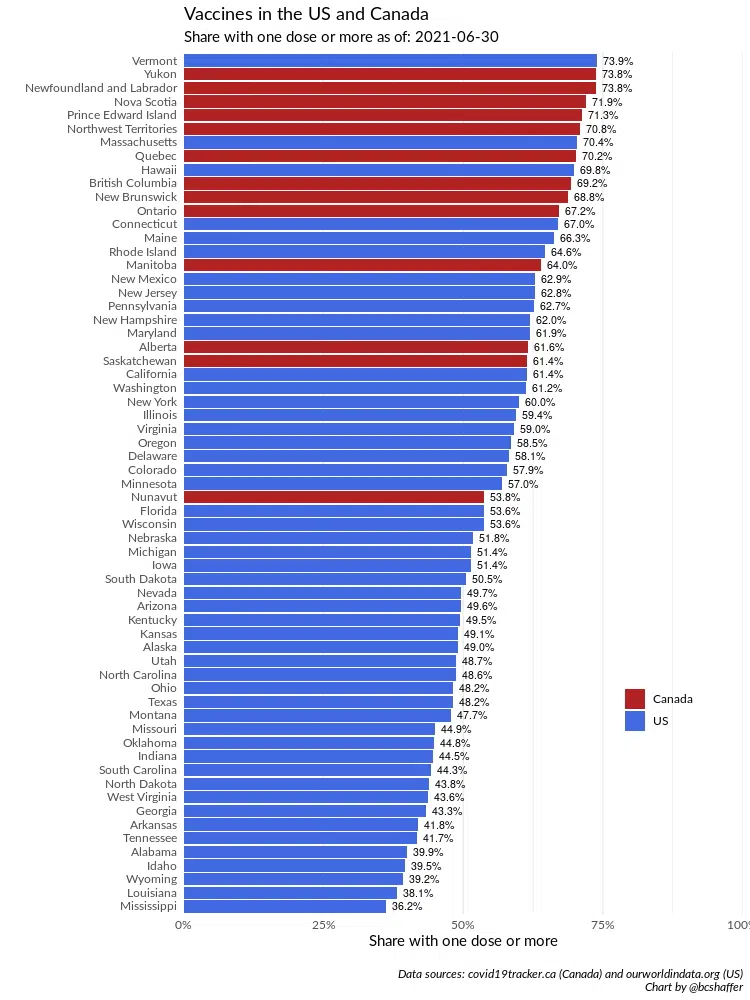
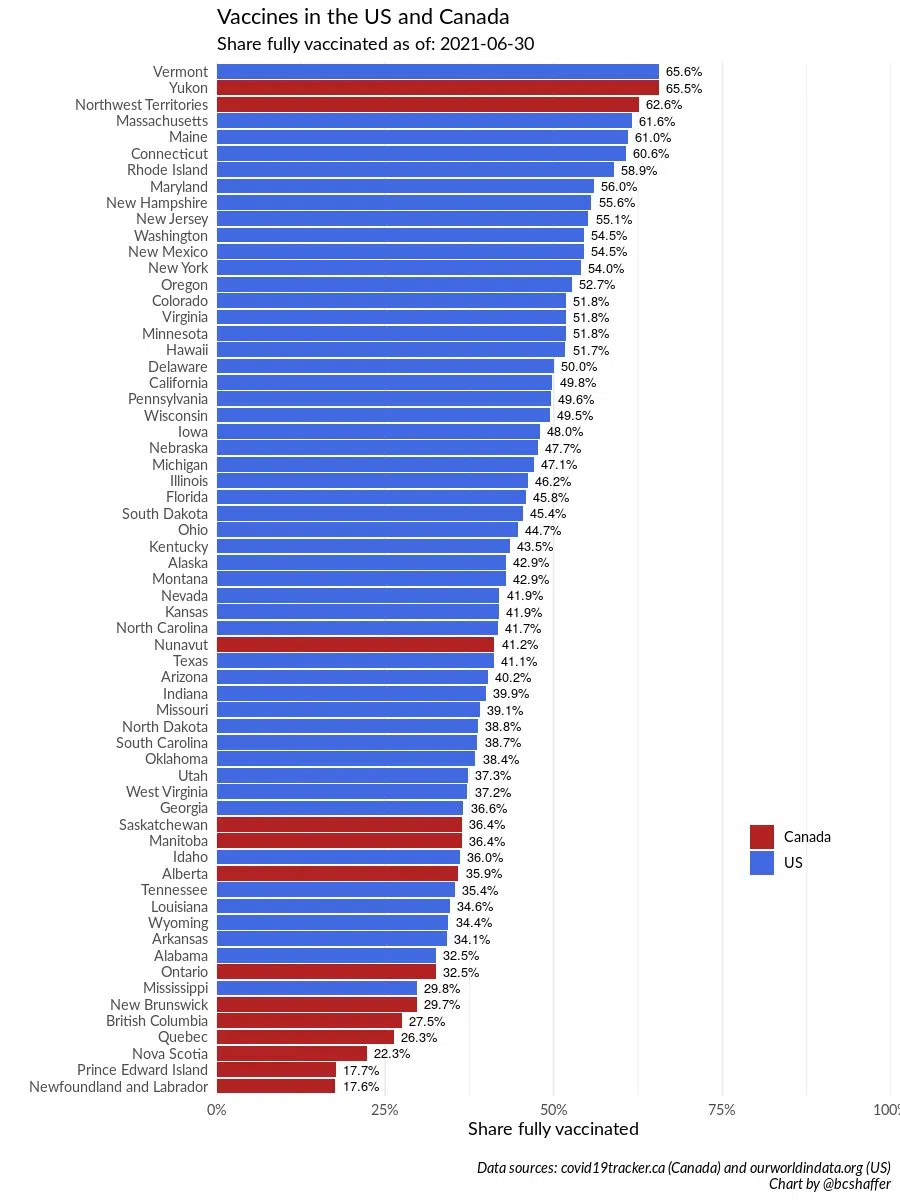
Newfoundland and Labrador is poised to become the most vaccinated place as a percentage of population in North America.
This is based on first vaccinations according to Blake Shaffer, an Assistant Professor of Economics at the University of Calgary.
Health Minister John Haggie says 80 per cent of the population is set to have had their first dose by the end of this week.
However, in terms of second doses of vaccines, the province is at the bottom according to Shaffer, sitting at just below 20 per cent.
Meanwhile, the Public Health Agency of Canada says Pfizer-BioNTech is sending more than 2.4 million doses to Canada this week along with about 1.4 million from Moderna.
Another 18 million doses are expected in July, enough to fully vaccinate all 33.2 million Canadians over the age of 12.