Rechercher dans ce blog

Rabu, 01 Desember 2021

'The door is open' to new Senators arena at LeBreton Flats: NCC - CTV Edmonton

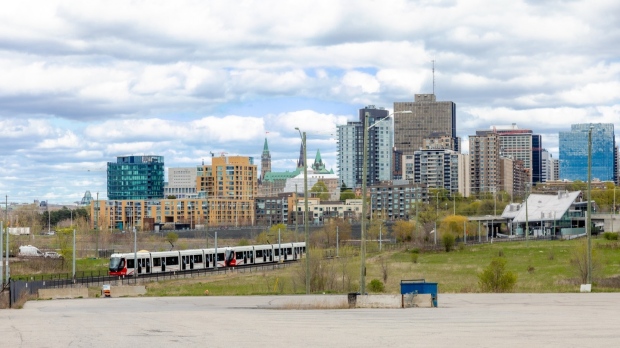
OTTAWA -- The National Capital Commission is seeking "bold and transformational" ideas for attractions at LeBreton Flats as it launches a new process to redevelop land on the site.

And the director of the LeBreton project says the NCC is open to a possible arena for the Ottawa Senators on the federally-owned land.

“The door is open,” Katie Paris told reporters on Wednesday. “We understand that the Senators owner has been vocal in the media about looking for another location for the arena. If it’s of interest of him or to the Senators, them the door is open.”

“But we also want to make sure that we get going on this project,” she added. “So we are looking for other ideas and we want to make sure that we consider the whole range of ideas before moving forward.”

The NCC has launched a request for expressions of interest for two parcels of the land just west of downtown, which the commission hopes will feature major attractions.

“This is a once-in-a-generation opportunity,” NCC CEO Tobi Nussbaum said in a news release. “We are looking for visionaries and trailblazers who share our passion and excitement for the possibilities of this incredible place. 

“We want to draw ideas for attractions that are both bold and transformational.”

The first site is a six-acre parcel of land along Albert Street between City Centre Avenue and Preston Street, east of the Bayview LRT station.

The other smaller site is a 1.2-acre parcel along an inlet of the Ottawa River, which the NCC says offers “an outstanding location for a smaller venue.”

“The major attractions are hoped to be a regional, national and international draw for sports, music and entertainment, arts and culture and/or recreational purposes,” the REI says.

The last time major attractions were planned for LeBreton Flats was when the Ottawa Senators-led bid to redevelop the site won preferred status in 2016.

That bid, which would have included an NHL arena, fell apart after a legal dispute between Senators owner Eugene Melnyk and development partner Trinity Developments. Melnyk has since mused about building a new arena in Kanata, near the Canadian Tire Centre. He has also floated Gatineau as an option.

Paris said she's confident the process to develop major attractions will go more smoothly this time around.

“It’s really different this time,” she said. The NCC has created a master concept plan for LeBreton Flats, starting with public consultation, grounding the major attractions in a larger vision, she said.

And she said the context has changed: the new library is under construction at the east end of the Flats, the NCC’s first land sale is in progress, and it has already developed a new pathway system on the land.

“We really do retain the flexibility over time to implement our vision in phases, as it’s done the world over,” she said.

The sites will become important anchors for the surrounding development, which will eventually become home to 7,500 residents and 4,000 workers.

“What does a major attraction look like? Some people think sports arena, some think concert hall, some think exposition space, and some have other ideas,” the REI says. “We are leaving the canvas blank so creative minds can suggest innovative and financially sound concepts that could capture our interest.”

Any proposal for a major events centre would need to identify a tenant, its use, and its financing sources, Paris said.

“The NCC does not want to be the owner of this building,” she said. “Our role is to offer the opportunity, offer the land, offer our spirit of partnership…to make this vision a reality.”

“If you tell us you want to do a certain type of facility, we would want to see your capacity and your experience and your ability to get that vision done.”

You can read the entire request for expressions of interest here. The NCC is asking proponents to submit their ideas by the end of February 2022. Evaluation of the proposals will take place in March and April.

Adblock test (Why?)


'The door is open' to new Senators arena at LeBreton Flats: NCC - CTV Edmonton
Read More

Natural Gas Price Forecast - Natural Gas Markets Continue to Plunge - FX Empire

Natural gas markets have plunged during the trading session on Wednesday as we continue to see the milder temperatures in the United States act like a wrecking ball for pricing. Unfortunately, most retail traders, and quite frankly quite a few professional ones, have no idea that this is a US contract. It does not matter what happens in Europe, and that is the most important thing that I can impart to you at the moment. The reason being is that the United States can only export about 12,000,000,000 ft.³ of natural gas, which is nowhere near to make a dent into what is going on in the European Union.

NATGAS Video 02.12.21

At the same time, temperatures in the United States falling of course would be bullish for this market but quite frankly this looks like another mild winter. In other words, demand is not going to be a strong as one would think. Furthermore, we are trading the January contract, so this is the absolute “peak season” for natural gas demand. If we continue to see temperatures look somewhat buoyant, that will mark the end of the trend.

Furthermore, I think that we have to worry about whether or not there is going to be enough industrial demand as there are a lot of concerns about the economy slowing down. Inflation seems to be peaking, and that has its say in this market as well. If that is going to be the case, then commodities in general could be in trouble. Natural gas was without a doubt overdone to begin with, and now that we have broken through the bottom of a massive descending triangle, it is possible that we continue to go much lower. I am now looking for signs of exhaustion to short.

For a look at all of today’s economic events, check out our economic calendar.

Adblock test (Why?)


Natural Gas Price Forecast - Natural Gas Markets Continue to Plunge - FX Empire
Read More

What Cargill workers want - CBC.ca

On a cold, windy November day, Freddy Vasquez cuts a small figure as the massive Cargill meat-processing plant near High River, Alta., looms behind him.

"Now hiring," reads a highway billboard propped up outside the plant, offering sign-on bonuses of $500 for day shifts and $600 for nights.

Hard hat on and mask affixed, Vasquez steps into a vehicle parked on the side of the highway. He says hello, takes off his hat and sighs deeply.

"I've got a massive headache today," he says. "I go to work with headaches. I come home with headaches."

Inside the plant behind Vasquez, union workers are voting in person on a new offer of settlement from the company. Among other measures, the offer features wage boosts and increased employee benefits.

"What we're asking is that, at least, they recognize what we're doing," says Alain Mendoza, who works on the harvest floor.

"All those things people don't want to do, we're the ones doing it."

For workers who have been without a contract since December 2020, this is a critical decision that, if accepted, will chart the course for employees at the plant for six years.

Cargill union workers haven't had a contract since December 2020. (Jamie Hopkins/CBC)

If this contract is rejected — and scuttlebutt around the plant suggests it will be — then the company and the union will go back to the drawing board.

Workers are interested in a raise, of course, but this contract represents something more important.

They say it's an opportunity to address years of unrealistic expectations driven by production that have led to injury and alleged mistreatment by superiors that have made many feel a sense of indignity.

All of this lands in the shadow of a massive COVID-19 outbreak in May 2020 that ripped through this plant, left hundreds sick and three dead. It colours all of the negotiations to come and remains extremely present to the people who experienced it.

This bargaining is a chance for employees to make their real, deeply felt frustrations heard, says Sean Tucker, an associate professor of human resource management at the University of Regina who specializes in worker safety.

"This dispute has the potential to lead to real improvement for workers at the High River plant, but also set a pattern for meat-processing workers at other plants in Alberta and across Canada," he says. "That's what I'll be watching closely."

There are sticking points. In the aftermath of the COVID-19 outbreak, workers aren't happy about the lack of paid sick leave in the proposed contract.

As a part of that outbreak, at least 950 staff tested positive for COVID-19. Two workers — 67-year-old Hiep Bui and 51-year-old Benito Quesada — died of COVID-19, as did Armando Sallegue, a worker's 71-year-old father.

The new contract proposes that a so-called "COVID bonus" of $1,200 will be paid out to all active employees — but that's contingent on the union and the company resolving a number of pending grievances tied to the plant shutdown last spring.

They'll need to come to an agreement soon or workers will go on strike in the cold of an Alberta December.

This poster, advocating for strike action, was placed on a locker inside the Cargill meat-processing plant in November. (Submitted by name withheld)

There's no question that a strike at this plant would have serious implications for Prairie ranchers, many of whom have been struggling with drought and high feed costs. Cargill provides around 40 per cent of all beef processing in Canada.

But the impacts of the COVID-19 outbreak that infected nearly half the workforce, as well as hundreds of family members and other close contacts, can't be forgotten.

Last year, after employees first began to test positive for COVID-19, some told CBC News they continued to work in close proximity despite physical distancing measures put in place by the company, adding that Cargill pressured them to return to work even after they contracted COVID-19.

The outbreak is the subject of a police investigation, although no charges have been laid. The company is also the target of a class-action lawsuit, the allegations of which have yet to be tested in court.

Workers say challenges at the plant existed before the COVID-19 outbreak and persist now.

They allege that production speeds are unrealistic and lead to injury and that worker shortages have put undue pressure on current employees. Others say they have felt harassed and disrespected by superiors while at work, sometimes being yelled or sworn at.

Adblock test (Why?)


What Cargill workers want - CBC.ca
Read More

Oil pares gain as OPEC meets to assess production and virus - BNN

Oil fell in another volatile session with the first identified U.S. case of omicron jolting markets ahead of OPEC’s meeting with partners tomorrow to discuss output production. 

West Texas Intermediate closed down 1 per cent, erasing earlier gains of as much as 5 per cent. The omicron variant continued to worry investors with the first case detected in California and a doubling of South Africa’s COVID-19 cases from Tuesday. Meanwhile, Federal Reserve Chair Jerome Powell reiterated that the bank must remain vigilant against inflation, which can be bearish for commodities if it takes steps to slow the pace of economic growth. 

“It was inevitable that Omicron would make it to the US, but when you combine how quickly it appears to be spreading across South Africa, energy traders are getting more concerned about the short-term outlook,” said Ed Moya, senior market analyst at Oanda Corp. “If omicron is much more transmissible we could see large parts of the country enter lockdown mode.” 

The Organization of Petroleum Exporting Countries and its allies are meeting this week to consider its output policy amidst concerns that the new variant could slow global oil demand.

Embedded Image

Some analysts expect OPEC+ to pause supply hikes in light of crude’s recent declines and worries that the omicron variant may dampen oil demand. The U.S. frustrated OPEC+ last week by announcing a release from its strategic reserves. 

There are indications that crude’s fundamentals have softened, reflected in a weakening price structure along the curve. Yet Goldman Sachs Group Inc. said Tuesday that oil prices have now “far overshot“ the likely impact of the new virus variant. 

OPEC+ has “erred on the side of caution since it began slowly boosting supplies,” said Stephen Brennock, an analyst at PVM Oil Associates. A potential decision to shelve January’s planned increase and keep quotas flat “comports with its cautious approach.”

Prices:

  • WTI for January delivery fell 61 cents to settle at US$65.57 a barrel in New York
  • Brent for February settlement fell 36 cents to settle at US$68.87 a barrel

In Washington, Powell said for the second time in two days that the bank should consider speeding up how quickly they withdraw policy support. A looming end to the taper could lead to an increase in interest rates to tamp economic growth and subsequently slow the recovery in commodity consumption. 

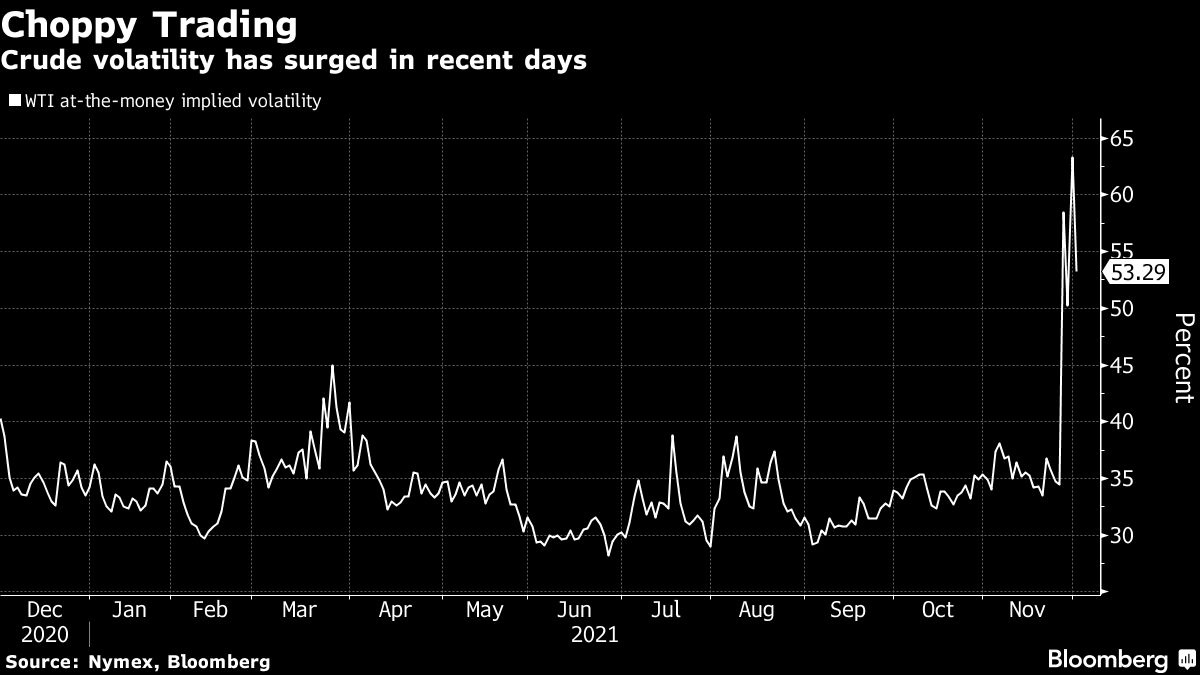
The battery of recent headlines and uncertainty triggered by the new variant has caused oil’s volatility to soar. WTI closed 13 per cent lower on Friday before climbing on Monday and slumping again Tuesday. Gauges of swings in both WTI and Brent are at their highest since May 2020.

Although oil remains in backwardation -- a bullish structure with near-term contracts trading above later-dated ones -- differentials have narrowed. Brent’s prompt spread was 30 cents a barrel, down from US$1.20 a week ago.

A U.S. government report showed that while overall crude inventories fell, stockpiles at the nation’s largest oil hub Cushing, Oklahoma, rose for the third straight week. Gasoline inventories rose 4.03 million barrels, the biggest week-over-week build since June.

Related coverage:

  • An increase in exports from some of OPEC’s major producers in November has put global oil flows on course for a large gain for a third consecutive month.
  • For the second time in a matter of days, the oil market was gripped by a frenzy of selling on Tuesday. Once again, the explanation could be found as much in options markets as in the omicron variant.
  • China has averted a diesel crisis after refiners quickly ramped up production, with excess supply now poised to be exported.

Adblock test (Why?)


Oil pares gain as OPEC meets to assess production and virus - BNN
Read More

Why Canada is unlocking its vault of maple syrup - CBC.ca

Canada's maple syrup industry has become an international focus in recent days, with headlines shouting that the country has been forced to tap into its strategic reserve to make up for shortages.

Quebec produces about 73 per cent of the all maple syrup in the world. And the Quebec Maple Syrup Producers (QMSP), an organization that governs the province's maple syrup producers, has said it will release about 22.7 million kilograms of maple syrup from its strategic reserve into the market by February.

For some, the headlines may have been an eye-opener that Canada even has a stockpile of maple syrup. CBC Explains the purpose of this reserve, why it had to be tapped into, and explores whether there was ever a shortage of maple syrup.

What is the strategic reserve?

Quebec's maple syrup industry is subject to a supply-management system, meaning it employs a quota system run by the QMSP which dictates market volume. The QMSP also controls the Global Strategic Maple Syrup Reserve, which can hold more than 45 million kilograms of maple syrup. 

The reserve was created in 2000 to keep syrup in stock and ensure a constant supply for national and international markets, regardless of the size of the harvest, Hélène Normandin, a spokeswoman for QMSP told CBC's As It Happens. 

One site, the Laurierville Plant and Warehouse, in the Centre-du-Québec region, covers an area of 24,805 square metres – the equivalent of five football fields. That site alone can store 25 million kilograms of maple syrup, or 94,000 barrels.

When properly stored in barrels, maple syrup can last for many years, said Michael Farrell, the former director of Cornell University's Uihlein Forest, a maple syrup research and extension field station in Lake Placid, N.Y. 

In years when the yield is good, and more syrup is produced than needed, the extra can be sold to the QMSP and stored  "so that when there's bad years, you have enough to keep people stocked up with syrup on their pancakes," Farrell said. 

"Without this in reserve [this year], there would be much less syrup up on store shelves, and the price would be much higher."

Why did they have to tap into the reserve this year?

In 2021, there was about 60 million kilograms of maple syrup produced, an average amount when compared to past years but down 18 million kilograms compared to 2020.

In this photo, a harvester taps a maple tree. Quebec's maple syrup industry is subject to a supply management system, meaning it employs a quota system run by the QMSP which dictates market volume. (CBC)

"It was an average season, not bad, but not as big as the two last seasons — 2019 and 2020 were just amazing, wonderful years of production," Normandin said.

However, worldwide demand has increased by more than 20 per cent — a spike industry experts believe was partly fuelled by more people cooking at home during the pandemic — and that has strained the supply

How did the weather affect the yield?

Not every year is a perfect year for every agricultural harvest. And this was one of those years which was not ideal in terms of maple syrup production, said Abby van den Berg, a research associate professor at the University of Vermont's Proctor Maple Research Center in Underhill, Vt.

Many places didn't have good weather for sap flow until later in the production season, she said.

In order for sap to flow, there has to be freezing temperatures, followed by above-freezing temperatures, she said.

"There just weren't that many sap flow days," Van den Berg said.

Was there really a 'shortage' of syrup.

'Canada tapping reserve maple syrup supply amid shortage' 

'Facing shortages, Canada taps its strategic reserve of maple syrup'

It was headlines like those that made Van den Berg bristle, she said.

"We had a year where the harvest was not super. It actually wasn't terrible. It wasn't as good as it had been in past years, and the reserve was there to perform its function," she said. "And there was no disruption in supply. There is no shortage."

"All of the headlines said 'maple syrup shortage,'" she said. "And literally, there is no shortage because of the reserve."

Jugs of maple syrup line a shelf. In 2021, there was about 60 million kilograms of maple syrup produced, an average amount when compared to past years but down 40 million pounds compared to 2020. (Hallie Cotnam/CBC)

Philippe Charest-Beudry, the owner of Ste-Anne-de-la-Rochelle, Que.-based Brien Maple Sweets, which packages and sells bottles of maple syrup, said his company has been able to fill every contract so far this year.

"I've not heard in the industry other players that we're not able to meet contracts," he said.

Has the reserve ever run into trouble with its stock?

Between 2011 and and 2012 around 3,000 tonnes were stolen from a storage facility in Quebec. But it was a few years earlier than that when the strategic reserve actually did run dry.

"People probably don't remember, but in 2008, after two or three years in a row of bad production, just bad weather, [they] ran out of syrup in the reserve," said Mike Farrell 

"There was nothing there and there wasn't enough syrup to go around. Prices spiked. We lost a lot of markets for pure maple syrup,"he said. 

A tree is tapped for maple syrup harvest. Many places didn't have good weather for sap flow until later in the production season, said Abby van den Berg, a research associate professor at the University of Vermont's Proctor Maple Research Center in Underhill, Vt. (CBC)

Ray Bonenberg, former president of the International Maple Syrup Institute and a maple syrup producer near Pembroke, Ont., said 2008 was an "awful year in production."

"It was abnormally cold until April 1st and then it got really warm, and I know my season was like eight days so it was disastrous," he said. "The reserve was right down to the bottom, and has been building it up."

What does this mean for next year?

Farrell said the 22.7 million kilograms of maple syrup represents a  "significant amount to take out the reserve this year." But what does that mean for the near future of the reserve?

There are currently around 50 million maple syrup taps in Quebec. In July, the QMSP approved the issuance of seven million new ones to meet the demand.

"From our  perspective, we believe it should solve the issue on the short term basis," said Charest-Beudry, "I don't see  a season next year where there's no more maple syrup in the grocery store."

Adblock test (Why?)


Why Canada is unlocking its vault of maple syrup - CBC.ca
Read More

Ontario passes new rules aimed at work-life balance for employees - CP24 Toronto's Breaking News

The Ontario government has passed new laws it says will help employees disconnect from the office and create a better work-life balance.

On Tuesday, the government said it passed the "Working for Workers Act," which requires Ontario businesses with 25 people or more to have a written policy about employees' rights when it comes to disconnecting from their job at the end of the day.

These workplace policies could include, for example, expectations about response time for emails and encouraging employees to turn on out-of-office notifications when they aren’t working, the government says.

According to the act, between January 1 and March 1 of each year an employer must ensure it has a written policy in place for all employees with respect to disconnecting from work.

"We are determined to rebalance the scales and put workers in the driver's seat of Ontario’s economic growth while attracting the best workers to our great province," Monte McNaughton, Minister of Labour, Training and Skills Development, said in a statement Tuesday.

The act also bans the use of non-compete clauses, which prevent people from exploring other work opportunities and higher salaries at other jobs.

According to the government, Ontario is the first jurisdiction in Canada, and one of the first in North America, to ban non-compete agreements in employment.

McNaughton says the new laws not only protects workers' rights, but also will help to attract top talent and investments to the province.

The act also removes "unfair" work experience requirements for foreign-trained immigrants trying to work in their professions. 

It also introduces a mandatory licencing framework for temporary help agencies and recruiters to help prevent labour trafficking.

"This legislation is another step towards building back a better province and cementing Ontario's position as a global leader, for others to follow, as the best place in the world to live, work and raise a family," McNaughton said.

A government spokesperson told CTV News Toronto that while the act has not yet received royal assent, it is expected to later this week.

Timelines for when each law under the Working For Workers Act will come into effect have not been announced yet and the government said it there will be a initial grace period for businesses.

Adblock test (Why?)


Ontario passes new rules aimed at work-life balance for employees - CP24 Toronto's Breaking News
Read More

Stocks sink on Powell’s hawkish taper remarks, Omicron alarm - Aljazeera.com

Fed Chair Jerome Powell signalled the United States central bank would consider speeding up its withdrawal of bond purchases as inflation risks increase. That further upset markets already battered by the looming threat of the Omicron COVID-19 variant.

Wall Street’s main indexes closed lower on Tuesday after Federal Reserve Chair Jerome Powell signalled that the United States central bank would consider speeding up its withdrawal of bond purchases as inflation risks increase, piling pressure onto a market already nervous about the latest COVID-19 variant.

In testimony before the Senate Banking Committee, Powell indicated that he no longer considers high inflation as “transitory” and that the Fed would revisit the timeline for scaling back its bond-buying programme at its next meeting in two weeks.

The S&P 500 – a proxy for the health of retirement and college savings accounts – lost 88.27 points, or 1.9 percent, to end at 4,567 points, while the tech-heavy Nasdaq Composite Index lost 245.14 points, or 1.55 percent, to 15,537.69. The Dow Jones Industrial Average fell 652.11 points, or 1.86 percent, to 34,483.72.

“Powell’s comments threw a monkey in the wrench in market thinking in terms of potential taper timing. You’re seeing as a result of that, risk-off across the board,” said Michael James, managing director of equity trading at Wedbush Securities in Los Angeles.

“You also have to factor in the Omicron variant concerns. You can argue whether they’re more headline risk or reality risk but regardless, it’s having a significant impact on oil, and everything that’s tied to economic growth.”

Powell’s comments also prompted speculation among some investors about a potential acceleration in interest rate hikes.

“The principal contributor to the decline in stock prices today is the Powell commentary, regarding the upcoming Fed meeting, about accelerating the tapering of their bond-buying programme, which obviously leads to the prospect that rate hikes come sooner next year,” said Mark Luschini, chief investment strategist at Janney Montgomery Scott in Philadelphia.

“That somewhat hawkish shift in tone caught the market flat-footed,” Luschini said.

Meanwhile, the market was also left waiting for information about how dangerous the Omicron variant might be, the degree to which current coronavirus vaccinations could offer protection and the additional restrictions governments might have to impose that could hurt the economy, Luschini said.

Tuesday’s declines were broad-based, with all the 11 major S&P sectors down. Communication services was the lead decliner by late afternoon. As oil prices tumbled, energy was also under pressure throughout the session.

Monday’s rally saw stocks regain some of the ground they had lost on Friday when the market first sold off on news of the virus variant.

While the US Food and Drug Administration said it hopes to have information about the effectiveness of current COVID-19 vaccines against Omicron, vaccine companies appeared divided.

BioNTech’s chief executive said the BioNTech and Pfizer COVID-19 vaccine will likely offer strong protection against severe disease from the variant, while Moderna Inc’s CEO told the Financial Times that COVID-19 shots are unlikely to be as effective against the new variant as they have been previously.

Moderna shares fell while those of Regeneron Pharmaceuticals Inc were also under pressure after it said its COVID-19 antibody treatment and other similar drugs could be less effective against Omicron.

Travel and leisure stocks slumped, with S&P 1500 Airlines and the S&P 1500 Hotels, Restaurant and Leisure indexes both declining on concerns of more border restrictions.

The virus uncertainty has triggered fresh alarm at a time when supply chain logjams are weighing on economic recovery and central banks globally are contemplating a return to pre-pandemic monetary policy to tackle a surge in inflation.

Adblock test (Why?)


Stocks sink on Powell’s hawkish taper remarks, Omicron alarm - Aljazeera.com
Read More

Finding rapid COVID-19 tests across Canada, from relative ease to utter frustration - Global News

While Ontarians were left empty-handed after hours spent waiting in line for free COVID-19 rapid antigen testing kits over the weekend, res...