Several retailers in Canada have launched their Cyber Monday deals.
Below is a round-up of some of the most notable offers and promotions:
Amazon
If you missed out on the mega deals from Amazon Canada’s ‘Black Friday’ sale, don’t worry, we have your back and have a list of Amazon’s ‘Cyber Monday’ deals.
All of these deals are live now and run until November 29th at 11:59pm ET/8:59pm PT.
Below are all of Amazon’s Cyber Monday offers:
Check out all of Amazon Canada’s Cyber Monday deals here.
But if you’re looking for more, the retailer has added new Cyber Monday pricing to the mix. Check out some of the top deals from Best Buy’s Cyber Monday sale below:
Walmart’s ‘Cyber week’ deals are live now, with a slew of discounts on laptops, TVs, headphones and more.
Check out some notable deals from the sale below:
Staples
With Black Friday deals out of the way, Staples Canada has just released its Cyber Monday promotions, with discounts on monitors, laptops, wearables, peripherals and more.
Find some of the notable deals from the sale below:
If you’re looking for a computer or tablet, there are a few notable Microsoft Cyber Monday deals for you. For example, if you buy a Surface Pro 8, you can get a $100 gift card that you can spend on apps and other things from the Microsoft Store. Further, the Surface Laptop 4 is down to $989 for the base model, which is $200 less than its regular price.
GameStop
GameStop’s Cyber Monday sale offers several notable deals, including Assassin’s Creed Valhalla and Immortal’s Fenyx Rising for $19.99. However, this price is only valid for the first 200 buyers, with both titles costing $29.99 after this point.
The sale starts at 12:01pm ET on November 29th.
Below are all of GameStop’s various Cyber Monday offers:
Nintendo
Nintendo’s digital Cyber Monday sale is live now, with several titles discounted at up to 50 percent off.
It’s worth noting that the titles mentioned above are on sale until Tuesday, November 30th at 11:59pm PT/2:59am ET. Find all Nintendo Cyber Monday deals here.
MobileSyrup utilizes affiliate partnerships. These partnerships do not influence our editorial content, though MobileSyrup may earn a commission on purchases made via these links that helps fund the journalism provided free on our website.
Toronto will host a mass vaccination clinic for school-aged children at Scotiabank Arena next month as it seeks to use the home of the Maple Leafs for a different type of shot than the ones that usually come off the stick of Auston Matthews.
The city has announced that it will make 2,000 appointments available for children aged five to 11 during a one-day clinic at the downtown arena scheduled for Dec. 12.
The clinic will run from 10 a.m. to 6 p.m. and will also include giveaways and music and entertainment throughout the day.
The announcement of the large-scale clinic comes on the heels of the vaccination of the younger age cohort getting underway last week following Health Canada’s approval of Pfizer’s pediatric vaccine the week prior.
Ontario’s Chief Medical Officer of Health Dr. Kieran Moore says that more than 68,000 children aged five to 11 have already received their first dose, accounting for about 6.4 per cent of those who are newly eligible to get vaccinated.
“It is a brilliant initiation for this strategy and I hope that volume of individuals continues so they (school-aged children) are best protected going into the holidays when we can anticipate seeing more cases,” he said during a briefing on Monday.
Highest number of school outbreaks since April
The effort to vaccinate younger children has taken on a renewed importance as an increasing number of COVID-19 outbreaks are declared at public schools.
There are now 189 outbreaks at Ontario schools, including 174 at elementary schools where most students remain unvaccinated.
It is the highest number of simultaneous outbreaks in schools since the peak of the third wave in April.
Back then the number of schools with outbreaks reached a high of 210 before officials ordered that all schools switch to remote-learning only following the delayed spring break.
Schools then remained closed until September, marking the second straight year in which in-person learning was heavily disrupted.
This year public health officials have insisted that they will prioritize keeping schools open, with plans to use raid antigen tests to ensure students returning to classes following the winter break have not contracted COVID-19.
There are, however, some worrisome trends beginning to present themselves in the data.
According to the latest figures provided by the Ministry of Education on Monday, there are now 1,591 active cases associated with Ontario’s public schools after another 131 new cases were reported over a 24-hour period ending last Friday afternoon.
Over the last week the number of active cases associated with the public school system has risen 25.7 per cent, outpacing the growth in Ontario’s active caseload during the same time period (21.7 per cent)
There are also currently 16 schools that are closed due to COVID-19 outbreaks or for operational reasons related to the pandemic.
That is nearly double the number of closures (nine) that were in effect at this time last week.
A count by CP24 has also determined that at least 155 individual classrooms in Greater Toronto and Hamilton Area school boards have been switched to remote learning following positive cases.
That is up 30 per cent from this time last week but is likely an underrepresentation of the true extent of the problem as some boards don’t publicly report the data.
Toronto to host mass vaccination clinic for children at Scotiabank Arena as number of COVID-19 outbreaks in schools continues to rise - CP24 Toronto's Breaking News Read More
(Kitco News) - The gold prices instinctively rose after reports of the new omicron COVID-19 variant was found last week. The momentum has somewhat died since then and the gold price has consolidated back around the volume point of control (VPOC) area on the chart. This area is marked by the red horizontal line and it represents where most contracts have been traded at what price.
This zone was extremely sticky in the past and if we are heading to another time like that $1800/oz seems like fair value for now. Away from this, the price is also back in the apex from the trendlines. When the price fell it found support at the upward sloping trendline marked in grey. Looking at levels lower down, the current wave low of $1777/oz could now be in focus and any break below could be seen as bearish. Beyond that, there are two support levels to watch at $1750/oz and $1720/oz respectively.
On the upside, the break of the triangle formations would be welcome for the bulls and the green consolidation high is another area of concern. The main resistance however is the previous wave high at $1879.5/oz. This is the level the price stopped at on the last decent run before central bankers were talking about accelerated tapering. Now the new variant is around maybe there could be a delay to the taper and the level could come back into focus.
Jack Dorsey, the CEO and one of the founders of Twitter, is expected to step down from his role ... causing the company's stock to make a massive jump.
A report from CNBC says Dorsey -- who is both the CEO of Twitter and Square -- is expected to step down from his executive role with Twitter as early as Monday. After the news, the stock jumped 11%.
It was just last year when Elliott Management -- the Twitter stakeholder -- had wanted Dorsey to step down, under the belief it was hard for him to effectively run both Twitter and Square at the same time. Both had come to an agreement back then to keep Jack on, but clearly, they've now decided differently.
Twitter was founded in 2006 by Dorsey, Biz Stone, Noah Glass and Ev Williams. Dorsey first served as CEO until 2008 and then took back over in 2015. He founded Square -- a digital payment company -- in 2009 and will almost certainly keep his role there.
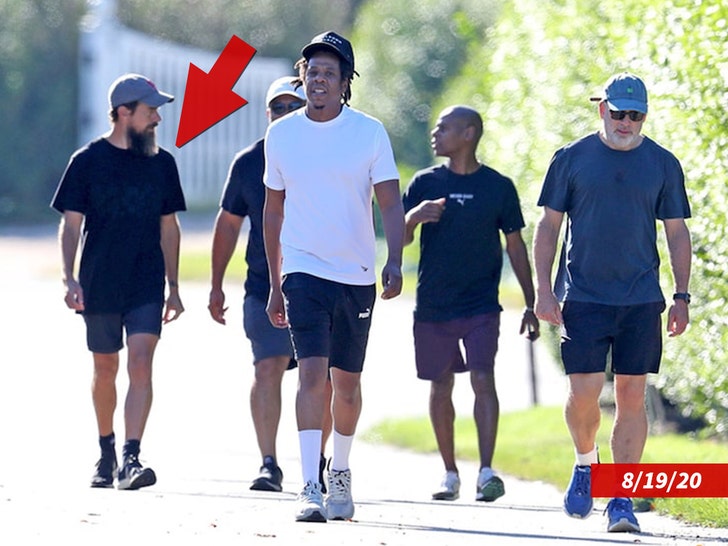
Of course, over the years, Dorsey made his fair share of celeb friends ... including Jay-Z. The two were spotted together in the Hamptons back in August.
And…this is unlikely and maybe against the creative process…but it would be incredible if @kanyewest put out #DONDA as it is now and continued to update it until he feels it’s “finished”…so we can all witness the work evolve in real time.
Artist Tina So moved from Hong Kong to Vancouver two years ago and needed a storage locker for some paintings and family heirlooms.
She signed up with Sentinel Storage in Richmond, B.C., comforted by the promise of a state-of-the-art security system.
That confidence was shaken when So opened her storage unit in August.
"I couldn't believe my eyes," she told Go Public. "I double-checked the door. I thought I entered some other person's locker."
Her major artwork from the past ten years, other paintings she had collected, family tableware and other heirlooms — all were gone.
"The first thing I did was run to the lobby and tell them that something's gone wrong!"
It was the beginning of a mystery So says should not be hard to solve, given that Sentinel Storage advertises that it is a gated property with round-the-clock security, video surveillance and individually coded access to doors and gates.
"You give everything that is valuable to them and there is no guarantee that they will keep it well," said So.
Have a question or something to say? CBC News is live in the comments now.
Thousands of people across the country have put their personal belongings in public storage, creating a $9-billion industry in Canada according to a January report by research company IBISWorld.
At the same time, the pandemic has led to business closures and job losses, driving an increase in theft from self-storage facilities, says security expert Alex Vourkoutiotis, chief technology officer at Caliber Communications in Hamilton, a company that provides various types of corporate security.
"Mass layoffs cause theft increase. It's an unfortunate byproduct, but it's a reality," Vourkoutiotis said.
Thieves left behind a handful of items, including a crack pipe which the RCMP retrieved for possible DNA analysis. (Submitted by Tina So)
There are no national statistics, but Vourkoutiotis says he and colleagues in the industry have noticed a definite spike in storage crime.
Theft attempts at facilities his company monitors have almost tripled — from 135 in 2020 to 348 in the first ten months of 2021.
A spokesperson for Sentinel Storage said no one was available for an interview to discuss So's case, but sent a statement, saying the company was "sincerely sorry about the loss," that security is "fundamental" to its service and that it works closely with law enforcement when theft has occurred.
Sentinel Storage is owned by the biggest player in Canada's self-storage industry, Toronto-based Storage Vault, which gave So confidence when she signed up to rent a locker for about $175 a month, including a mandatory insurance policy that's common in the industry.
"The building looked very secure," said So. "And they advertised 24-hour surveillance. So I thought, 'This is the place.'"
So and her husband visited the locker in March 2020.
Inside the Sentinel Storage facility in Richmond, B.C., where So mysteriously lost the entire contents of her storage locker. (Submitted by Tina So)
Because of the pandemic, the next time they checked was in August 2021 — when they discovered the theft. Company records said no one else had entered the locker.
When So first signed up with Sentinel, she was instructed to use a code on a keypad to open a sliding door.
She was told that each customer gets their own access code and that her code was the last seven digits of her phone number.
"They did not tell us that we can change it," said So.
Using a personal phone number for an access code can be a security issue, says Vourkoutiotis, because anyone who knows you or can see a customer's number in the system will know the code.
"We recommend against that," he said. Still, he says, storage companies often do it "because managing the code system becomes difficult."
The RCMP constable who investigated says Sentinel Storage did not have video surveillance of the theft. (Submitted by Tina So)
The padlock on the locker appeared to be untampered and the door was not jimmied. The walls and ceiling of the storage unit were intact.
None of it makes sense to So.
"It's not a Houdini box," she said, referring to famous escape artist Harry Houdini.
Insurance policies switched
Even more perplexing, a Sentinel employee had erroneously cancelled her obligatory $5,000 insurance policy, and placed another customer's $2-million policy under her account.
It was a "clerical error" Sentinel admits, but visible to anyone who had access to the internal system, prompting So to wonder if it may have piqued interest in the contents of her locker.
Adding to her frustration, So says Sentinel Storage refused to answer many of her questions — so she posted her experience on Facebook and other platforms, calling the company "totally unreliable, negligent and not trustworthy."
This 2013 painting by So, titled Into the Storm, is one of many artworks stolen from her locker. (Submitted by Tina So)
Others have shared similar stories, about storage companies big and small, including those owned by Sentinel. Dale Ladoon of Edmonton says his Sentinel locker was broken into last month, but the company didn't let him know for three days.
"Basically, Sentinel did not help at all," he writes in an online review on Trustpilot.
Rob McNeill writes on Google Reviews that his Lethbridge, Alta., locker was broken into in May and there were "items stolen, no follow up."
Lily Love also posts on Google Reviews that her Sentinel locker in Coquitlam, B.C., was broken into in March and "they didn't contact me about it 'til four months later!"
Sentinel said it couldn't comment on unhappy customers "to maintain the integrity of ongoing investigations."
The missing video
Most storage facilities have security cameras and advertise their surveillance as a selling point. Sentinel wouldn't tell Go Public whether it has any video footage of So's theft and said it couldn't reveal how long footage is stored, so as not to compromise any security features.
But the RCMP constable investigating So's case told her that Sentinel does not have any video of the theft.
WATCH | Cherished belongings disappear from storage locker:
Cherished belongings stolen from self-storage despite security claims | Go Public
13 hours ago
A Vancouver woman who kept cherished belongings in a self-storage facility is frustrated after her items were stolen despite promises of 24-hour security. Experts say storage theft has become a growing problem during the pandemic. 2:11
"It's very disappointing," said So. "The whole purpose of having 24-hour surveillance cameras is to use it when something happens. It's not a prop."
The strongest protection from theft comes when those cameras are monitored around the clock by a third-party surveillance company, says Vourkoutiotis — which is what his company does for industries ranging from self-storage to auto dealerships to utilities.
"If you don't have an active, monitored system, then you run the risk of just going in after the fact and perusing video footage — that may or may not exist — to determine what happened or maybe who did it," he said.
Go Public randomly called 20 public storage facilities, from Victoria to St. John's, to ask about video surveillance. The locations are owned by the country's 10 largest storage companies — including StorageVault, U-Haul, StorageMart, Public Storage and Apple Self Storage — to ask about video surveillance.
All the companies said they use security cameras. Some only use cameras at the entrance/exit to a facility, others had cameras inside, at the loading bays and down corridors.
Security expert Alex Vourkoutiotis says video surveillance footage is often only kept for four to six weeks. (Keith Burgess/CBC)
None of the employees could say how long the video footage from those cameras is stored — some guessing "a few months," others suggesting it might be available "for years."
None of the companies employed third-party monitoring of their premises and none said the cameras were watched 24/7, the employees said.
"If they don't have a monitored system, but you are interested in using their services, I would find out what kind of procedures they put in place to ensure that the camera system stays operational," said Vourkoutiotis.
"And at least understand how long they store footage." Because most places he's aware of don't save video footage longer than four to six weeks, Vourkoutiotis recommends customers check in on their storage units once a month.
Sentinel said it will honour So's original insurance policy and that she can file a claim — as long as she provides receipts for the stolen items.
"Which is kind of bizarre," said So. "You don't save your receipts on your family heirlooms."
She's patiently waiting for the results of the police investigation, but is losing hope that anything will come of it. In the meantime, So has contacted local art galleries and provided photos of some of her stolen artwork.
She's offering a $5,000 reward for any information that will help solve the theft. "I want to find out the truth," she said. "What happened is heartbreaking and devastating."
So says she was told to use the last seven digits of her phone number to access the area with her storage locker. A security expert says that’s poor protection. (Erica Johnson/CBC)
Submit your story ideas
Go Public is an investigative news segment on CBC-TV, radio and the web.
We tell your stories, shed light on wrongdoing and hold the powers that be accountable.
If you have a story in the public interest, or if you're an insider with information, contact GoPublic@cbc.ca with your name, contact information and a brief summary. All emails are confidential until you decide to Go Public.
Artist Tina So moved from Hong Kong to Vancouver two years ago and needed a storage locker for some paintings and family heirlooms.
She signed up with Sentinel Storage in Richmond, B.C., comforted by the promise of a state-of-the-art security system.
That confidence was shaken when So opened her storage unit in August.
"I couldn't believe my eyes," she told Go Public. "I double-checked the door. I thought I entered some other person's locker."
Her major artwork from the past ten years, other paintings she had collected, family tableware and other heirlooms — all were gone.
"The first thing I did was run to the lobby and tell them that something's gone wrong!"
It was the beginning of a mystery So says should not be hard to solve, given that Sentinel Storage advertises that it is a gated property with round-the-clock security, video surveillance and individually coded access to doors and gates.
"You give everything that is valuable to them and there is no guarantee that they will keep it well," said So.
Thousands of people across the country have put their personal belongings in public storage, creating a $9-billion industry in Canada according to a January report by research company IBISWorld.
At the same time, the pandemic has led to business closures and job losses, driving an increase in theft from self-storage facilities, says security expert Alex Vourkoutiotis, chief technology officer at Caliber Communications in Hamilton, a company that provides various types of corporate security.
"Mass layoffs cause theft increase. It's an unfortunate byproduct, but it's a reality," Vourkoutiotis said.
Thieves left behind a handful of items, including a crack pipe which the RCMP retrieved for possible DNA analysis. (Submitted by Tina So)
There are no national statistics, but Vourkoutiotis says he and colleagues in the industry have noticed a definite spike in storage crime.
Theft attempts at facilities his company monitors have almost tripled — from 135 in 2020 to 348 in the first ten months of 2021.
A spokesperson for Sentinel Storage said no one was available for an interview to discuss So's case, but sent a statement, saying the company was "sincerely sorry about the loss," that security is "fundamental" to its service and that it works closely with law enforcement when theft has occurred.
Sentinel Storage is owned by the biggest player in Canada's self-storage industry, Toronto-based Storage Vault, which gave So confidence when she signed up to rent a locker for about $175 a month, including a mandatory insurance policy that's common in the industry.
"The building looked very secure," said So. "And they advertised 24-hour surveillance. So I thought, 'This is the place.'"
So and her husband visited the locker in March 2020.
Inside the Sentinel Storage facility in Richmond, B.C., where So mysteriously lost the entire contents of her storage locker. (Submitted by Tina So)
Because of the pandemic, the next time they checked was in August 2021 — when they discovered the theft. Company records said no one else had entered the locker.
When So first signed up with Sentinel, she was instructed to use a code on a keypad to open a sliding door.
She was told that each customer gets their own access code and that her code was the last seven digits of her phone number.
"They did not tell us that we can change it," said So.
Using a personal phone number for an access code can be a security issue, says Vourkoutiotis, because anyone who knows you or can see a customer's number in the system will know the code.
"We recommend against that," he said. Still, he says, storage companies often do it "because managing the code system becomes difficult."
The RCMP constable who investigated says Sentinel Storage did not have video surveillance of the theft. (Submitted by Tina So)
The padlock on the locker appeared to be untampered and the door was not jimmied. The walls and ceiling of the storage unit were intact.
None of it makes sense to So.
"It's not a Houdini box," she said, referring to famous escape artist Harry Houdini.
Insurance policies switched
Even more perplexing, a Sentinel employee had erroneously cancelled her obligatory $5,000 insurance policy, and placed another customer's $2-million policy under her account.
It was a "clerical error" Sentinel admits, but visible to anyone who had access to the internal system, prompting So to wonder if it may have piqued interest in the contents of her locker.
Adding to her frustration, So says Sentinel Storage refused to answer many of her questions — so she posted her experience on Facebook and other platforms, calling the company "totally unreliable, negligent and not trustworthy."
This 2013 painting by So, titled Into the Storm, is one of many artworks stolen from her locker. (Submitted by Tina So)
Others have shared similar stories, about storage companies big and small, including those owned by Sentinel. Dale Ladoon of Edmonton says his Sentinel locker was broken into last month, but the company didn't let him know for three days.
"Basically, Sentinel did not help at all," he writes in an online review on Trustpilot.
Rob McNeill writes on Google Reviews that his Lethbridge, Alta., locker was broken into in May and there were "items stolen, no follow up."
Lily Love also posts on Google Reviews that her Sentinel locker in Coquitlam, B.C., was broken into in March and "they didn't contact me about it 'til four months later!"
Sentinel said it couldn't comment on unhappy customers "to maintain the integrity of ongoing investigations."
The missing video
Most storage facilities have security cameras and advertise their surveillance as a selling point. Sentinel wouldn't tell Go Public whether it has any video footage of So's theft and said it couldn't reveal how long footage is stored, so as not to compromise any security features.
But the RCMP constable investigating So's case told her that Sentinel does not have any video of the theft.
WATCH | Cherished belongings disappear from storage locker:
Cherished belongings stolen from self-storage despite security claims | Go Public
11 hours ago
A Vancouver woman who kept cherished belongings in a self-storage facility is frustrated after her items were stolen despite promises of 24-hour security. Experts say storage theft has become a growing problem during the pandemic. 2:11
"It's very disappointing," said So. "The whole purpose of having 24-hour surveillance cameras is to use it when something happens. It's not a prop."
The strongest protection from theft comes when those cameras are monitored around the clock by a third-party surveillance company, says Vourkoutiotis — which is what his company does for industries ranging from self-storage to auto dealerships to utilities.
"If you don't have an active, monitored system, then you run the risk of just going in after the fact and perusing video footage — that may or may not exist — to determine what happened or maybe who did it," he said.
Go Public randomly called 20 public storage facilities, from Victoria to St. John's, to ask about video surveillance. The locations are owned by the country's 10 largest storage companies — including StorageVault, U-Haul, StorageMart, Public Storage and Apple Self Storage — to ask about video surveillance.
All the companies said they use security cameras. Some only use cameras at the entrance/exit to a facility, others had cameras inside, at the loading bays and down corridors.
Security expert Alex Vourkoutiotis says video surveillance footage is often only kept for four to six weeks. (Keith Burgess/CBC)
None of the employees could say how long the video footage from those cameras is stored — some guessing "a few months," others suggesting it might be available "for years."
None of the companies employed third-party monitoring of their premises and none said the cameras were watched 24/7, the employees said.
"If they don't have a monitored system, but you are interested in using their services, I would find out what kind of procedures they put in place to ensure that the camera system stays operational," said Vourkoutiotis.
"And at least understand how long they store footage." Because most places he's aware of don't save video footage longer than four to six weeks, Vourkoutiotis recommends customers check in on their storage units once a month.
Sentinel said it will honour So's original insurance policy and that she can file a claim — as long as she provides receipts for the stolen items.
"Which is kind of bizarre," said So. "You don't save your receipts on your family heirlooms."
She's patiently waiting for the results of the police investigation, but is losing hope that anything will come of it. In the meantime, So has contacted local art galleries and provided photos of some of her stolen artwork.
She's offering a $5,000 reward for any information that will help solve the theft. "I want to find out the truth," she said. "What happened is heartbreaking and devastating."
So says she was told to use the last seven digits of her phone number to access the area with her storage locker. A security expert says that’s poor protection. (Erica Johnson/CBC)
Submit your story ideas
Go Public is an investigative news segment on CBC-TV, radio and the web.
We tell your stories, shed light on wrongdoing and hold the powers that be accountable.
If you have a story in the public interest, or if you're an insider with information, contact GoPublic@cbc.ca with your name, contact information and a brief summary. All emails are confidential until you decide to Go Public.
OTTAWA - The signs of an unprecedented labor shortage in Canada are glaring: hospital emergency rooms closed because of a lack of nurses, restaurants skipping meals and fewer Santas in malls.
In Ottawa, a "Help Wanted" notice in the window of Corazon De Maiz restaurant -- like those in storefronts across Canada -- has gone mostly unanswered since the recent lifting of public health restrictions introduced 19 months ago to slow the spread of the coronavirus.
The end of Covid-19 lockdowns brought droves of customers to the capital city eatery, but with kitchen staffing levels down, the restaurant has been unable to meet the demand for burritos and tacos.
"We're suddenly busier, but we're having to close early because my wife and I are exhausted after working all day," owner Eric Igari told AFP.
One new hire worked three hours and quit, saying the job was too hard for not enough pay, Igari said.
"We've asked friends to pitch in, and even a few regular customers offered to help," Igari said. Two customers actually worked a few shifts.
NO 'HO HO HO'
Studies by the government and industry associations found that up to two-thirds of Canadian businesses are facing worker shortages, and claim the deficit is limiting their growth.
The industries most affected are health care, food services, manufacturing and construction.
According to the latest from Statistics Canada, there were a total of 1,014,600 job vacancies in September, including 196,100 in food services and 131,200 in health care -- double the numbers from two years ago.
Trevin Stratton, a partner at Deloitte Canada, said factors contributing to the shortfall include an aging population leaving the workforce and lower recent immigration due to travel restrictions -- which Canada lifted in September.
Some sectors are adapting through the use of technologies such as increased automation in manufacturing, e-commerce in retail, or allowing staff to work from home.
But in others, "many workers might not necessarily yet feel comfortable working somewhere where their physical presence is required," Stratton said.
This is particularly true in the restaurant industry, which also shed workers fed up with the cycle of lockdowns and re-openings throughout the pandemic. "They're now looking for more stability," Stratton said.
With Christmas just weeks away, the trend has also impacted the supply of Santa actors usually hired for photos with children on their knee at shopping malls or professional mixers.
Jeff Gilroy of Just Be Claus said he's turned down 200 Santa gigs in Ontario. After large gatherings were banned last Christmas, he told AFP, "people are looking to have a Santa to make it a more festive Christmas."
Catherine Lacasse of the Professional Santa Claus Agency of Quebec said her province has ample Santas, "but we're struggling to find enough elves."
NURSES' BURNOUT
"In health care, we've seen an exodus, particularly of nurses this year," Stratton said. "Some of that has to do with the stress of the job right now."
Lachine hospital in Montreal was forced to close its emergency room at night due to a "critical shortage of nurses," said spokeswoman Gilda Salomone.
Several others, she said, "are experiencing a major labor shortage that is limiting the quality and access to care."
Observers have suggested simply raising salaries to lure workers.
But Jasmin Guenette of the Canadian Federation of Independent Business (CFIB), said this "isn't an option for many small businesses still struggling to recoup pandemic losses."
"We see things slowly getting back to normal, going out to restaurants, for example, and we think that means businesses are doing well. But that's not the case. The impact of the pandemic was severe, and is still being felt," he said.
According to a CFIB survey, the average small business in Canada racked up Can$170,000 (US$135,000) in debts over the pandemic. And an estimated 180,000 businesses, or one in six, are now "at risk of closing."
Chez Mere-Grand restaurant in Montreal sought for 21 weeks to hire a cook and a barista. Its owner Romain Beiso explained that the hiring pool is smaller because many people now insist on a better work-life balance and job security found in other sectors.
"Our wages are not competitive because we cannot afford it," he also acknowledged.
Over at Hotel Place d'Armes, manager Benoit Pretet worries about being short 25 staff going into the holiday season.
"The clientele is back," he said, "but we can't open all our rooms."